EazLink guide
What is fiscal compliance middleware?
Fiscal compliance middleware connects the systems that create sales to the systems that approve, record, or verify those sales for tax purposes.
Short answer
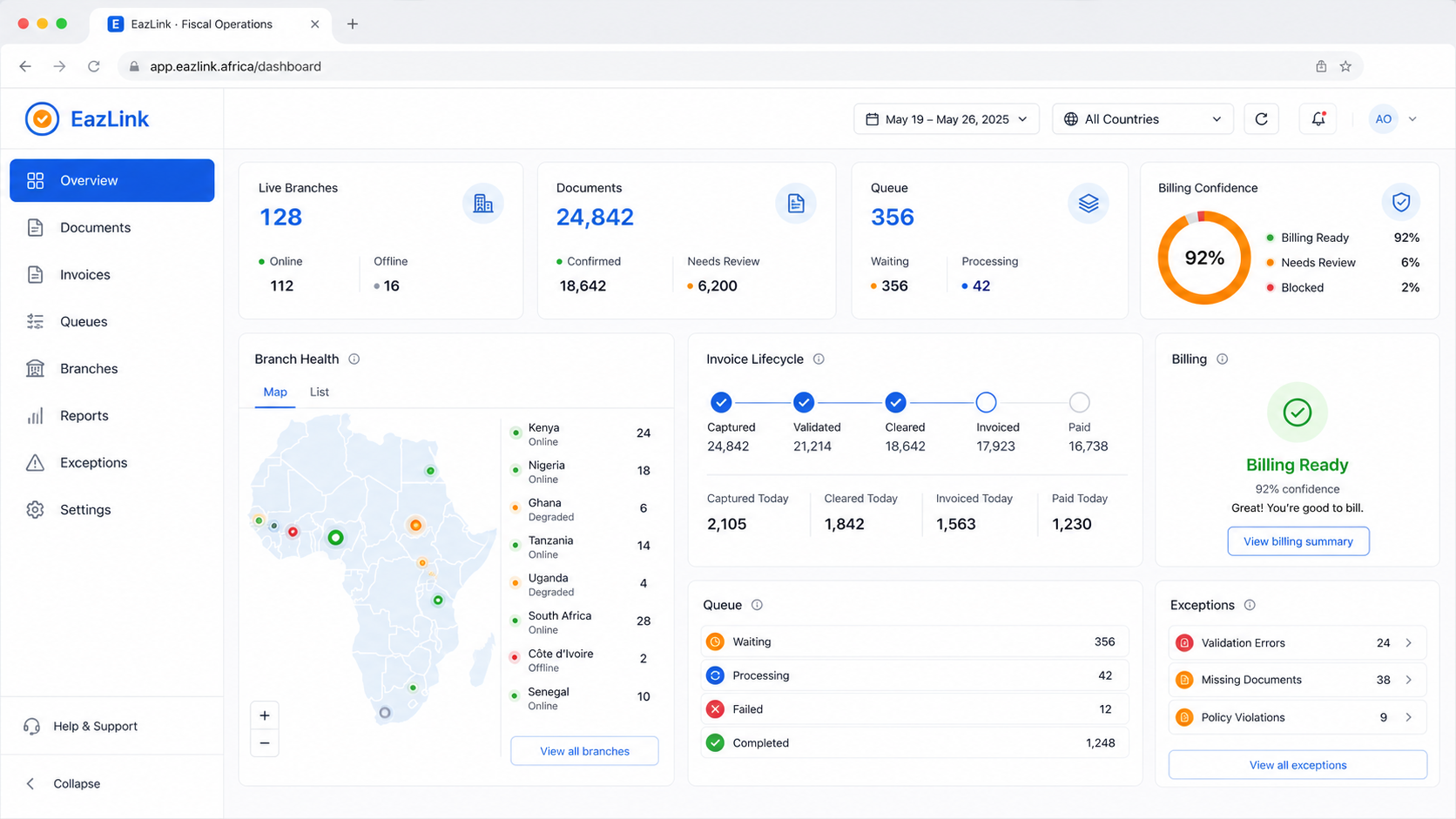
Fiscal compliance middleware is the layer between ERP, POS, ecommerce, and tax authority systems. It gives each sale a controlled path: receive the transaction, prepare it for the country workflow, return proof, track failures, and keep a usable record for finance and support.
What to remember
- Middleware is useful when tax authority work starts touching sales, receipts, branch uptime, and support.
- The sales system should not have to carry every local rule, response format, retry pattern, or proof file.
- A good fiscal layer makes failed and waiting transactions visible before they become finance clean-up work.
- EazLink is strongest when a business or partner needs the same operating model across more than one system or market.
The problem it solves
Most companies already have a working way to sell. A cashier uses a POS. A distributor creates invoices in an ERP. An ecommerce site collects orders. A branch may use a local tool because the network is unreliable. Those systems were built to record the sale, take payment, manage stock, or move the order to finance.
Fiscal rules ask for another job. The sale may need a tax authority number, a receipt code, a QR value, a device identity, a certificate, a confirmed status, or a rejection reason. If the ERP or POS has to learn all of that country by country, the business ends up turning checkout software into tax infrastructure.
- The POS needs to know whether it can issue a receipt.
- Finance needs to know which documents are accepted and which need attention.
- Support needs enough detail to fix an error without digging through raw logs.
- Partners need one delivery story they can repeat across customers.
Where the middleware sits
The cleanest place is between the sales system and the fiscal process. The ERP, POS, ecommerce site, or branch system sends the sale once. The fiscal layer handles country preparation, submission, status, receipt proof, retries, and audit history.
That does not mean every country becomes identical. It means the business gets one operating view while each country keeps its own fiscal path behind the scenes.
What buyers should ask before choosing one
A buyer should ask how the product handles the ugly cases as well as the happy path. What happens when the network drops after the sale is captured? What does the cashier see if the tax authority is slow? Can finance export the proof later? Can a partner tell whether the problem is data, certificate, branch connectivity, or tax authority response?
If the answer is a raw error code and a support ticket, the product may be a connector rather than an operating layer.
- Can it keep transaction status visible to business users?
- Can it retry without double-charging or duplicating proof?
- Can it support more than one ERP, POS, or country path?
- Can it separate branch problems from head-office problems?
Where EazLink fits
EazLink is built for businesses and partners that do not want fiscal compliance scattered inside every sales system. It keeps the sales flow, fiscal status, proof, retry path, and partner support view in one layer.
That matters most when a company sells through several channels, works across multiple African markets, or needs dealers and implementation partners to support customers without rebuilding the same fiscal logic every time.
A practical buying checklist
- List every system that creates a sale: ERP, POS, ecommerce, mobile sales, branch tools, and file imports.
- Map the countries where fiscal proof is already required or likely to be required soon.
- Decide who needs status visibility: cashier, finance, branch manager, partner support, or headquarters.
- Test a weak-network case before go-live, not after the first branch complains.
- Ask the vendor to show accepted, rejected, queued, retried, and confirmed examples.
Quick questions
Is fiscal compliance middleware the same as an accounting system?
No. An accounting system records and manages business accounts. Fiscal compliance middleware connects sales events to tax authority workflows and brings back status, receipts, and proof.
Does a business need to replace its POS or ERP?
Usually no. The point is to keep existing systems and add a fiscal layer between those systems and the tax authority path.
When does EazLink make the most sense?
EazLink makes sense when fiscal work affects several systems, countries, branches, or partner teams. A single small branch may survive with a manual process. A growing business usually needs a cleaner layer.